Tuesday, 15 February 2011

Lenses on a life

An elderly relative of mine died recently and it’s made me think about the different lenses with which you can review someone’s life, and how that enables you to focus on different things.


(cc) freephoto

Looking through my family member spectacles, I focus on my feelings toward her, my memories of her, my sense of the sort of person she was and her place in the complex web of emotions that makes up any family.

Wearing my historian’s glasses, I think about the times she lived in and how that illuminates my sense of the past. When I think about non-conformist working class life in the early 20th century, I picture her birth family. When I think about changing attitudes to disability, I remember her exclusion from elementary school, and hence formal education, for a relatively minor disability. When I think about the impact of the NHS, I think about her recurring hospital treatments, both pre and post-NHS, and how those treatments shaped and improved her life.

If I put on my social gerontologist’s spectacles, I feel angry and despairing about her low quality of life in her later years, even in a relatively ‘good’ care home and in a much less socially isolated context than many care home residents. I also remember what a lot I learned about being an informal carer from just a fortnight of living with her after she came out of hospital one time.

With my feminist spectacles on, I think about how her female gender intertwined with her disability and her status as ‘youngest child of large family’ to position her within the family as the one who needed looking after. I speculate about how differently this might have played out had she been born a disabled boy.

As a sociologist with a particular interest in sexuality and relationships, I think about how a working class woman came to marry a much older widower from a wealthy family. And think about how complex her class position ended up being, with not much money but some fabulous Victorian furniture.


(cc) Tom

I don’t know whether my relative is going to have an obituary published anywhere, but if she does, it will probably talk about her love of music, her decades of service as a churchwarden and organist, her employment as a physiotherapy assistant, her short but happy marriage, her love of dogs and her sense of humour.

I’m struck by how partial all these pairs of spectacles are. Each of them brings only one aspect of her life into focus. While you can combine some of the lenses without giving yourself too much of a (theoretical) headache, they still do not even approach the rich complexity of a single, unremarkable woman’s life.

I guess that’s something of the enduring fascination to me of biographical approaches to the study of social life.

Cross-posted from rememberingmyhat.wordpress.com

Monday, 14 February 2011

Ageing in perspective

We social gerontologists talk about ageing and reckon a centenarian or supercentenarian to be pretty old, but when biologists talk about ageing they mean REALLY old.

I loved this sequence of oldest living things, starting with a self-cloning plant reckoned now to be 43,000 years old and ending with Galapagos tortoises, mere striplings at 150-odd years old.

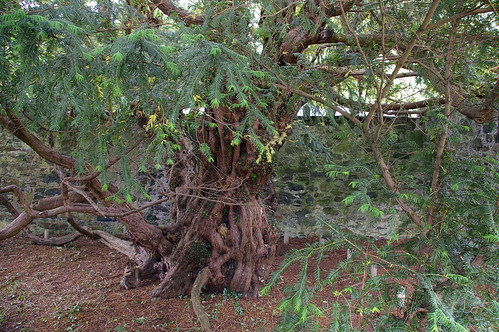
I also enjoyed this Radio 4 programme about yew trees, the oldest of which they reckoned to be 5,000 years old.


(cc)(Alex)

I was amused that the website makes no reference to yew trees, and the Radio 4 programme made a claim for the 5,000 year old yew tree to possibly be the world's oldest living thing. I guess biologists don't always do their lit reviewing properly, just like social gerontologists.

Friday, 14 January 2011

The case against the BBC

Did anyone see Jon Snow interviewing Mariella Frostrop on Channel Four News two nights ago. It was following the O'Reilly case and the issue of gender was raised in a peculiarly self-regarding sexist way. Was this just another example of ageism hitting the media headlines to be immediately upstaged by sexism?

Friday, 19 November 2010

CABS 15th Anniversary Event

This event was such a feast of fascinating perspectives on research projects, biographical approaches, and their contribution to challenging understandings and changing practice. I loved what all the different speakers said and I've just been catching up by reviewing the videos on http://stadium.open.ac.uk/stadia/preview.php?whichevent=1583&s=1

I was particularly fascinated by the audio extract played to us by Joanna Bornat from one of the South Asian doctors who came to the UK to work in the NHS and found a future in geriatric medicine. He was interviewed by Parvati of Joanna's team, and he told of his transformation of a centre for 'incurables' - where he was supposed to just keep an eye on hopeless cases in a ward which no one had ever left - into a rehabilitation mode that gave people the opportunity to do physiotherapy and improve. His first quadriplegic man who had been written off progressed to the point where he was able to walk and return to his business as a butcher!

This took place in the 1970s and I remember my first job as a medical social worker at an orthopaedic hospital at that time - I don't recall the patients I saw ever being given the terminology of incurable but I do remember thinking that orthopaedic surgeons were at a bit of a loss if they couldn't find an operation to do.

Well done CABS - as well as many other virtues, biographical approaches give us the opportunity to revisit our own biographies and understand a little better the unfolding of history in our time.

Jill Reynolds